Showing posts with label Awesomenauts. Show all posts

Wednesday, 17 March 2021

Super flexible 2D animations through the Blightbound Skin Editor

Last week I discussed how we used After Effects and Duik as our animation tools for Blightbound, achieving crisp animations at high framerates with small filesizes and nice tools for our animators. The real strength of this workflow however comes from our Skin Editor. This makes it possible to reuse animations, quickly tweak the looks of characters, swap gear, add special effects and attach objects to characters convincingly. Today I’d like to explain the ideas behind our Skin Editor and how this impacted the work of our artists.

As I showed in last week’s blogpost, the basic idea behind animations in Blightbound is that a character is made up of parts (hands, torso, face, upper arms, lower arms, etc.). These parts move and rotate and the game plays that back directly, instead of using sprite sheets.


Characters in Blightbound are animated using parts, and frame-to-frame variations on those parts. This shows some of the parts used in the animations of Malborys.

Since the game knows exactly what parts there are and where they are, there are a lot of fun things we can do with this besides simply playing back animations. How cool would it be to swap parts to create new characters, to swap weapons, to attach special effects to weapons and to attach effect-over-time animations to bodyparts? To achieve all of these things our artists made sure all characters have a similar structure, and I developed our Skin Editor.

The basic idea behind our Skin Editor is that it finds all the visible parts in all the animations for a rig and allows changing or hiding them. So a skin can change whatever it wants: a character’s head, weapon, shoulder, or even everything. When an animation is played back in-game, we inform it which skins are active and those are applied to modify the character’s looks during gameplay.


A demonstration of the interface and the various features of the Blightbound skin editor.

Skins allow us to create a new character by drawing new parts, without needing to create any new animations. This was an important goal for us, because for Blightbound we wanted quite a lot of characters. A core idea behind the game is that it should be a bit like Pokémon: gotta catch em all. There are a lot of playable heroes and the player collects those during gameplay. However, for Awesomenauts it took us 8 years to get to 34 characters and here we needed more animations per character and more characters (enemies included). So the Awesomenauts workflow wasn’t going to work and we needed to apply more reuse instead. The Skin Editor made this possible.

Note that above I said we apply skins, plural. Our skin system allows combining several skins, as well as changing which skins are active on the fly. A skin can add parts, but it can also remove or replace parts from the skin below it. This is pretty cool, because it allows us to do all kinds of cool things. For example, weapons are skins, so swapping a weapon means swapping a skin while keeping the base body skin the same.
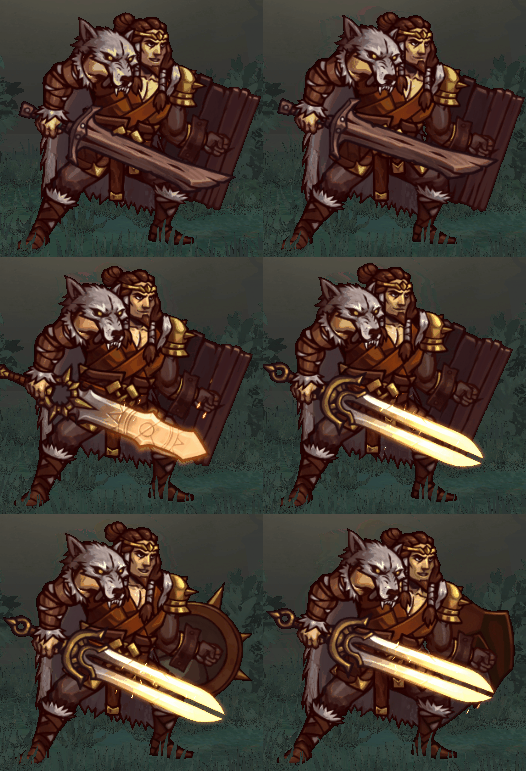

Weapons and shields are easily swapped by enabling and disabling additional skins.

Weapons are an obvious application of this, but we can do more outlandish stuff with this. If an enemy gets hit by a knife that applies a bleed effect (damage over time), then we would like to have an effect on the enemy for the duration of the bleed effect. In Awesomenauts we were heavily limited in these kinds of effects because the sprite sheet didn’t tell us where any of the limbs or feet of the character were. This meant status effects needed to be visualised with animations that are always centered on the character. In Blightbound we can do much better: we can have a knife sticking our of a leg, and the knife will move correctly with the leg. All it takes is adding a skin to the enemy that contains that knife.

Normally we put textures in skins, mostly body parts and clothing and weapons and such. But we also have a feature to attach any in-engine animation to a skin. This allows us to do things like adding sparkly particles to a staff, dripping blood to the knife, glows to the shackles, trails, and even physics capes. We also use this to attach gameplay dummies to skins, for example to make sure projectiles come out of the tip of the staff, no matter where that staff is in the current animation.


The skin system allows us to accurately attach visuals for status effects to the animation. Here the slow effect attaches to the legs. Also, the cape is a nice example of attaching a physics object to the character.

A fun but mostly unused feature I implemented is the scaling of parts. Skins can not just replace parts, but also change their size. We hoped we could use this to change a character’s silhouette, for example by giving one character longer arms and shorter legs. This feature also allows making all heads bigger (which is a common Easter egg in many games, but we didn’t add it to Blightbound).

While scaling worked fine from a technical perspective, in practice it was hard to make good looking characters this way so our artists ended up hardly using that feature. Also, a more complete implementation of limb scaling requires animation retargeting (for example to keep feet firmly on the ground when the ratio between upper and lower legs is changed), which is some pretty advanced tech that we didn’t have time to dive into.

So far it might seem like just having that skin editor enables all of these cool features. However, to make this work, all animations need to have consistent elements. For example, if we want to attach that knife to that underarm, then each animation that the character can play needs to have an underarm and it always needs to have the same name. In some cases we worked around this by adding empty visual parts to the rig, so that any characters that needed those parts could enable them. This is somewhat similar to adding attachment dummies to a skeleton in 3D animation.

Also, if we want to quickly reskin a character, then we should limit how many unique parts there are. In my previous post I mentioned that we do frame-to-frame animation on parts, for example by drawing several heads with different expressions. For every new character we add on this rig, we need to draw all of those heads. The larger the number of parts, the more work it is to add a new character that replaces all of those parts.

There are some tricks that we used to decrease the workload. For starters, our skinning system falls back to the default if variations don’t exist. If for example one character has a mask, then we don’t need to make copies of that mask for different facial expressions. If a character is less important then we can also just choose to not draw the facial expressions for that character, even if they wouldn’t be hidden by a mask.
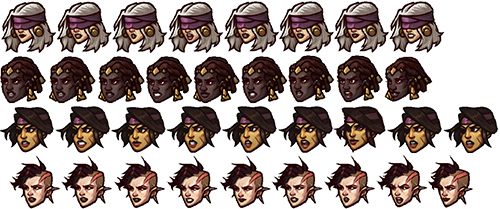

For each character we need to draw all the parts used in all their animations. For four characters in Blightbound this shows all the heads needed for the female rig. Note that some characters have one head fewer. That's okay because in such cases our skin system automatically falls back to the default.

Another thing we used is that not all characters use all animations. Enemies for example share some animations with heroes, but their animation set is a lot smaller. Enemies therefore only need to have the parts that are actually used in their animation set. For this same reason our animators had a lot more flexibility in adding parts whenever they made a character-specific animation: none of the other characters need to have those parts.

By carefully choosing which parts and variations are really needed, our artists managed to keep it all doable. Still, in total Blightbound currently has over 4,600 character parts. Together these form around 50 characters (players and enemies), 104 weapons and 45 shields.

This did require a lot of experimenting with exactly how a body is made up. While the basic parts may seem straightforward, there are a lot of subtle choices to be made. For example, feet are split in the front part (including the toes) and the back part, and the pelvis and torso are split. Also, some parts are in the rig twice: once in the front and once in the back, for more clothing possibilities.
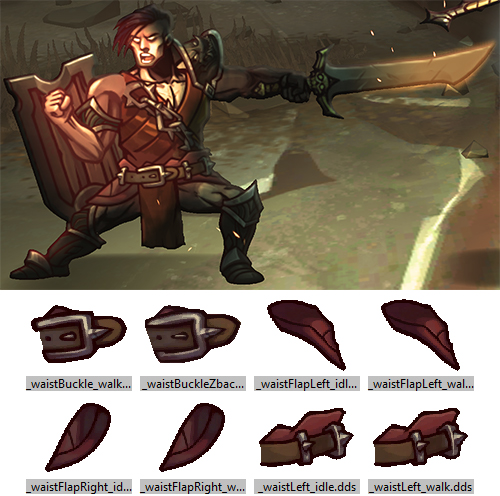

Our artists spent a lot of time figuring out exactly how the rig should be split into parts to be able to do a lot of poses and clothing variations without introducing too many parts. For example, here we see that the belt is split into 3 parts and there are "waistflaps" in the rig.

This brings us to the biggest downside of this approach: it adds a lot of limitations to what our animators can do. For each animation they need to creatively reuse the existing parts as much as possible. They can add new parts when it’s really needed, but they need to be very conservative with this to avoid bloating the workload. The result is that animations are a bit less dynamic that in Awesomenauts and Swords & Soldiers 2. Also, our artists generally did not enjoy the extra challenge of these limitations.

Another downside is that reusing animations makes characters a lot more similar visually, and limits what we can do in terms of body types. Our artists did go out of their way to make the characters as visually unique as possible within the limitations of the rig, for example by adding variation through extreme headgear, capes and clothing.

To make characters feel more unique, our artists have made select unique animations for each hero. Especially the idle animations are different, but in some cases also the walk animations. That’s one of the nice things of reuse: during development you quickly have a full character in the game with all animations, and then later on you can replace specific animations to make them more unique.


To make characters that use the same rig less samey, most have a unique idle animation.

Animation reuse is also great for prototyping: if for example a designer wants to try swapping skills around between enemies, they get an animation set for free to get a better idea of what gameplay feel that will have. In Awesomenauts on the other hand that often required an artist to make some extra concept frames for skill visualisation.

Before I finish this blogpost I would like to point out that the Skin Editor and the limitations we applied to be able to reuse animations are not necessary when using After Effects and Duik for animations. It’s perfectly possible to let go of all of those limitations and still get all the benefits that I discussed in last week’s blogpost. In fact, our After Effects exporter is technically capable of exporting Awesomenauts characters without using sprite sheets.

Despite the downsides, the scope of Blightbound would not have been doable for us without the approach we used. The combination of the Skin Editor and the consistent body setup that our artists applied to all animations made a lot of cool things possible for Blightbound. We were able to make more characters then we could otherwise have, create swappable gear, add special effects to weapons and attach animations to body parts. In total, I think the result is pretty spectacular. Also, playing around with the Skin Editor is just plain fun!

To conclude, here’s a video that shows what happens when you repeatedly randomise all parts of a character:


The Blightbound dev tools contain a feature to randomise skins. The results look both horrible and hilarious.

Special thanks to Ronimo artists Koen Gabriels, Tim Scheel and Gijs Hermans for providing feedback on this article.

Wednesday, 10 March 2021

Finding a suitable toolchain for animating Blightbound’s 2D characters

For Blightbound our technical ambitions for the 2D animation system were quite lofty: we wanted high quality animation, screen-filling bosses, crisp character art, high framerate and swappable gear. This required a complete rework of our animation pipeline, since the sprite sheets we used in Awesomenauts and Swords & Soldiers 2 allow for none of those requirements, except for high quality animations. In today’s blogpost I’d like to explain the problems we faced, and what combination of tools we chose to solve them. This is the first half of a two-parter: next week I’ll discuss our skin editor and its implications on animation.


Blightbound features huge screen-filling bosses that need to animate smoothly without taking up insane amounts of memory.

Traditionally 2D animation in games is done using sprite sheets. A sprite sheet is simply a big texture with all the frames for all a character’s animations in it. Sprite sheets aren’t limited to just character animation: they can also store other things, like special effects or plants. The frames might be in a grid, or spaced more efficiently like we did for Awesomenauts. In any case, it’s just a series of tightly packed images.

Sprite sheets are great because they allow for complete freedom. The animator can draw anything they like and it will just work. Extreme squash-and-stretch? Perspective changes? Morphs? Do as you please, to the game it’s all just images!

However, sprite sheets come with a few huge downsides. First is size. If you have a big character and want it to be crisp and high-resolution, then each frame is going to take up a lot of space. Having lots of large images is going to cost too much memory. In Awesomenauts this was indeed a problem for some of the characters. For Clunk to fit in one 4096*4096 sprite sheet (the maximum we chose for memory and compatibility reasons), we had to either lower the resolution a bit, or reduce the framerate. And that’s not even that big of a character! The high memory usage of sprite sheets means that screen-filling bosses either can’t be done, or need to have very few frames, or can’t be crisp.


In Awesomenauts, red Clunk occupies an entire 4k sprite sheet texture for all his animation frames. Clunk fit only after slightly downsizing him.

The second major downside of sprite sheets is that since it’s just images, it’s very hard to do anything with them except simply showing them. For Awesomenauts we’ve often talked about letting players customise characters by changing for example their hat or other parts, but simple sprite sheets make that incredibly hard. The engine would need to know where the hat is exactly, but the sprite sheet doesn’t contain that information. Nor does it tell us whether there are different perspectives of the hat in different frames, or whether anything is ever in front of or behind the hat.

I can think of some workarounds for this problem, but it’s all so cumbersome that’s it’s not practical to actually do. This is the main reason why Awesomenauts only contains skins that swap the entire look of a character, and no swappable hats or clothing: those would be completely new sprite sheets for each combination.


Since every skin change in Awesomenauts requires an entire new sprite sheet we decided to make full reskins instead of allowing the user to customise individual parts (like hats or weapons). These are the four looks for Ted McPain.

So, sprite sheets can’t give us four of our requirements (screen-filling bosses, crisp character art, high animation framerate and swappable items). What can we do instead? The obvious direction for a solution is to split a character in parts, and let those parts move relative to each other. Or even to go for full skeletal animation.

If you have a background in 3D animation, you might think “well skeletal animation of course, it’s awesome!” And in 3D it is indeed, but in 2D it’s a lot more limited. Because we’re restricted to the 2D plane, there’s a lot of animation that can’t be done with a standard skeleton in 2D. Rotating the head of the character away from the camera is super easy in 3D, but impossible with 2D skeletal animation. Swinging a sword vertically is easy, but horizontally is very hard because that requires 3D perspective. Wanting to circumvent these limitations, we opted for a combination of 2D skeletal animation and traditional frame-to-frame animation on parts where needed.

A common tool for doing part-based 2D animation is Spine. Spine is used by a lot of games and we expected this to be our best option. We tried Spine and it was indeed quick and easy to use, as well as easy to integrate into our own engine. However, it turned out to be a bit too simple: Spine doesn’t allow swapping a part in the middle of an animation. This is needed if you want to mix skeletal animation with frame-to-frame animation, for example by switching to a different drawing of a head or hand. The workaround was to layer several skeletons on top of each other, but that was too clunky to work with. We reached out to Spine at the time, explaining this issue, and they confirmed this was the only way. Our evaluation was three years ago and we haven't tried Spine since, but according to this post by them their options for combining frame-to-frame with skeletal animation seem to have improved recently.


Spine by Esoteric Software is a 2D character animation tool for games for creating animations using parts, skeletons and deformations (screenshot taken from one of Spine's tutorial videos).

We also tried some other tools, including Blender and 3D Studio MAX, but those turned out to be too focussed on 3D to create a good workflow for 2D animation for us. Especially the nice skeletal systems they have became quite impractical when used for 2D animation.

So instead, we wanted to stick with After Effects. After Effects is mostly known as a tool for editing video and doing special effects and such, but it’s actually also just a really good general animation tool. Our artists happily used it for character animation in our previous games Awesomenauts and Swords & Soldiers 2. The basic idea is this: each part in an animation is a layer, and can be animated, linked and deformed freely. By turning layers on and off, you can do frame-to-frame animation on parts (like a hand opening and closing) or on the character as a whole.

I imagine After Effects would be a bad fit for full hand-drawn frame-to-frame animation, like in Cuphead, since After Effects doesn’t even allow drawing on layers directly (we draw all our parts in Photoshop). However, for our games it’s an excellent tool because we don’t want to redraw the entire character every frame anyway.

There was something missing though: After Effects is a great animation tool, but it’s not really tailored to 2D character animation. Good thing we already knew about the Duik plug-in. Duik adds the rigging features that are common in 3D animation to After Effects. Combined with the strong tools After Effects already has, it’s a really effective 2D animation tool for games.


Duik is an After Effects plugin that adds tons of 2D animation features (screenshot from this tutorial video by Motion Tutorials).

I previously mentioned we wanted to mix skeletal animation with frame-to-frame animation. That part is actually really simple with Duik. The artist just links several drawings of a part to a bone and switches which is visible. This way we can change facial expressions during animations, as well as do things like open and close hands, pivot or distort a torso and switch facial expressions.


Thumbnails of most animation parts needed for one character in Blightbound. The various hands, faces and chests are for frame-to-frame animation on parts of the body.

Happy with After Effects+Duik as our animation tool, another important thing was missing: After Effects files can’t be played back in real-time engines. So I set about the task of writing an exporter from After Effects that exports all the hierarchy and animation data. I also implemented the in-game side of playing that back in real-time.

At it’s core, this is a surprisingly simple task. Each part in an After Effects animation is a layer and we can just export all the layers with their animation frames and play them back. Where I went wrong though, is that I wanted to emulate Duik’s systems in-game. I thought Duik only did basic two-bone inverse kinematics and implemented that in the engine. This worked with simple animations, but for complete characters the animations were completely broken in-game. When I looked deeper I learned that Duik actually has a ton of different animation systems and approaches. Mimicking all of those in-game was totally undoable.


Duik has so many features that only supporting parenting and two-bone IK produced completely wrong results in-game, as can be seen in this 'beautiful' monstrosity. This was intended to be a normal walk animation, early during development of Blightbound.

Once I realised this, I went for an easy alternative: animation baking. I export the orientation, scale and position of each part at 30 frames per second, simply storing the values for each frame (unless they’re not changing). This is a lot more data, but compared to the size of textures it’s really negligible. I did keep the hierarchy of the bones, so parts don’t start to subtly 'float' compared to each other.


Our custom file format is simply a text file with a long list of all parts and the information needed to position and animate them correctly, including parenting and keyframes.

I previously said we wanted high framerate. The game actually interpolates between these frames, so while they’re exported at 30fps, they’ll also run smoothly at 60fps, 144fps, or any other framerate. That’s also great for when slowing an enemy: in Awesomenauts, if you slow an enemy, you can see the low framerate of their slowed down walk animation. In Blightbound, movement remains perfectly smooth.

A note there is that whenever something needs to jump from one position to another instead of smoothly interpolating there, the artist needs to use a hold key. Our tool exports those and applies them correctly during playback. Overlooking this caused some bugs here and there, because artists aren’t used to needing to use hold keys when two frames are directly next to each other. In-game however there can be frames in between, so that case still needs a hold key.


A few animations that Ronimo animator Tim Scheel made for the Blightbound character Karrogh.

After Effects is a huge tool with tons of features, so it’s impossible to support them all in-game. Our exporter only supports what we actually need, and nothing else. This means our artists need to avoid using some After Effects features that they might want to use. In most cases this is fine, but one particular feature that we ended up not supporting due to a lack of time, is mesh deformations (also known as puppet pins). Being able to deform a part would have helped a lot, but we didn’t find the time to implement a good emulation of After Effects’ deformation features in-game. Quite a pity, and I wonder whether our artists have ever wished they had chosen Spine after all, since Spine supports deformations in-game out-of-the-box.

Our artists did apply a simple workaround for the lack of deformations. By doing them in Photoshop and saving them as different frames for a part, they work fine. Technically the engine then thinks it’s frame-to-frame animation, but it’s actually deformed instead of redrawn in Photoshop. This approach wasn’t used much because it requires a lot of handwork, especially when reusing animations on several characters, but it does get the job done when needed.


The chest deformation in this animation from Blightbound was made by deforming the chest part in Photoshop and then exporting it as separate parts.

From a memory perspective the result of our toolchain is pretty impressive. Whereas a single Awesomenauts character can take up 16mb of texture space (excluding skins and the blue team), all Blightbound characters and enemies together use only 65mb of texture space, spread out over 4,600 character parts. On top of that, Blightbound animations are much higher resolution and higher framerate and we can swap parts and weapons dynamically.

What we have so far is strong animation tools (After Effects + Duik) and a way to play animations back in-game. This is enough to make a playable game, but we wanted considerably more: easy reuse of animations between characters, equippable gear, attaching special effects to bodyparts and efficiently handling thousands of character parts. In next week’s blogpost I'll dive into how we achieved those goals using our own skin editor.

Special thanks to Ronimo artists Koen Gabriels and Gijs Hermans for providing feedback on this article.

Sunday, 15 November 2020

5 years below minimum wage: the financial history of Ronimo

Starting your own game company is fun and exciting, but it’s also challenging. It takes courage and skill, but above all: patience and perseverance. Some become successful quickly, but in many cases it takes years to achieve financial success and actually make a decent living out of your own game company. It might take long to make your first product or get your first deal, and that first achievement might only be a stepping stone towards a next step that brings financial stability. Today I’d like to show an example of just how long that can take by sharing the financials of the first five years of Ronimo, the company I co-founded with 6 friends nearly 14 years ago.

TLDR: The very short summary is this: it took us 2 years to make any money from Ronimo at all, 4 years to earn (almost) our country’s official minimum wage and 6 years to receive a more decent monthly salary from our own company. During that period we were near bankruptcy twice. Why did it take so long? Read on and you shall know!

A note before I continue: this blogpost is partially about how long it took us to “make a decent living”, but the cost of living differs hugely per country. The Netherlands is a wealthy country so cost of living is relatively high. A quick internet search shows that cost of living is much higher in some countries and only half in others. Since most revenue is worldwide, the same sales might mean financial stability in one place, but not enough to pay the rent in another.

Also, for anyone used to reading US dollars instead of euros: if you just replace the € sign with a $ sign, you’re in the right ballpark (especially given that the exchange rates between dollars and euros have varied a lot over the years).

In our second year of studying at the Utrecht School of the Arts our classmate Fabian Akker brought up the idea of starting a company together, with a group. Around that time we had done a couple of school projects that had failed quite miserably, so my first thought was: “we suck, let’s not.” However, the third year was to bring the first major game project, so we figured that if we could make something awesome there, then maybe we could also start a company making our own games.

The resulting game was De Blob: a huge success! We put it online and got attention from gaming press and even had some publishers contacting us, wondering whether they could buy the rights to De Blob.

(Note that De Blob was not exactly made by Ronimo: of the 9 students who made De Blob, only 5 were part of the 7 founders of Ronimo.)

Convinced by De Blob’s success, we decided to really go through with starting our own company. However, each of us still had to do a 7 months graduation project. We combined them and made starting Ronimo our graduation project. Getting school to approve of that was a bit of a struggle, but once they did, we even got our own office inside school.

At the time, 'indie' as it's known today hardly existed and we had definitely never heard of it. We thought the only way was to make retail games and that required funding from a publisher. So we set out to make a pitchable prototype: Snowball Earth. This was intended to be a Nintendo Wii game and we hoped to find publisher funding once we had graduated. At this point Ronimo didn’t make any money at all, but that was okay since we were still students.

September 2007. We were so focussed on pitching to publishers that we did our graduation stuff on the side and crunched for what came a few weeks later: Games Convention in Leipzig, Germany! There we pitched to at least a dozen publishers. Some were interested and continued conversations with us afterwards. Hopeful, we continued work on the game, looking to improve it and increase our chances of signing a deal.

Our very first presentation was for a then pretty famous person from a big company. He was so excited that… he feel asleep during out presentation. Jet lag. Or disinterest. Or both. When we woke him up, he proceeded to try to sell us his own middleware and hardly looked at our game.

By this time we had graduated and had moved to our own office in Utrecht. A very small office for 7 people, but it was cosy and exciting. What we didn’t have, however, was money. We did some minor work-for-hire jobs, but since we weren’t fully committed to that, we hardly made any money there. Just enough to pay the rent of our office, but definitely not enough to provide ourselves with any income.

This is something I've seen quite a lot: studios who want to make their own games and finance that with work-for-hire rarely succeed at both. Either they hardly make any money from the work-for-hire, or they spend so much time on that that they can hardly focus on their own game. Often the result is that the game takes many years to build and turns out mediocre because of the lack of focus and time. The reason for this is simple: doing work-for-hire well and making it lucrative is hard and it's rare for that to work as an aside, especially for inexperienced recent graduates.

So, we didn’t make any money and we weren’t students anymore. How did we not starve? This varied amongst the founders. First of all, in September 2007 we managed to sell all the rights to De Blob to THQ, a then major publisher that’s now defunct. (Note that THQ Nordic is a different company that later bought the rights to the name and games of THQ, including De Blob.) For this we were each paid a nice amount (can’t disclose it due to NDA unfortunately), enough to pay the rent for quite a while. However, only 5 of the 7 Ronimo founders were part of the De Blob team, so 2 others didn’t have this.

Six of the founders had an additional source of income: the now defunct WWIK government subsidy. This paid recent art graduates around €600 per month. That’s less than half of the official minimum wage in the Netherlands at the time, but enough to not starve. To live cheaply, three of Ronimo’s founders rented an apartment together with one more person.

I personally didn’t get WWIK because I had some savings and thus didn’t qualify, so I went even cheaper: I kept living with my mum until I was 26 years old. I have a lovely mum though so I totally didn’t mind. Thanks, mum!

This is also a good moment to mention how privileged we are to be doing this in the Netherlands. In many places in the world all of this would have been much harder.

So, how did the pitching go? A few publishers were interested and one even flew over to do due diligence: judging whether we would really be able to make the full game. In the end none of them actually offered us a deal because Snowball Earth was too unique and we were too inexperienced to be trusted with that much money. We were asking for €1.5m development budget. Not much for the big game we envisioned, but definitely too much to give to a bunch of students who had so little clue about business and production processes.

Snowball Earth was too big a game to finish without funding, so we ended up cancelling it altogether. Years later we did release our prototypes, which you can still find here together with videos and screenshots.

What next, then? By this time indie was on the rise and we had managed to get Nintendo Wii devkits. We decided to make something small that we could finish and publish ourselves: Swords & Soldiers for WiiWare (the predecessor of the current Nintendo eShop).

We estimated we could make this game in 3 months. One year later, we finished and launched it. I’m still impressed that we managed to make something of that size and quality in just one year, and I’m even more impressed that we were stupid enough to think we could make something like that in just 3 months...

Throughout this year we still didn’t make any money, but we did hire interns. In the Netherlands internships are a standard part of many schools and are not paid like normal jobs. So for only €200 per month we could have a game student work for us full-time. Despite that low compensation, those interns were getting more money from Ronimo than we were! On average, we had 2 or 3 interns at a time helping with development.

In May 2009 Swords & Soldiers launched on Nintendo Wii. It got critical acclaim, reached the #1 selling spot on WiiWare in Europe and #3 in America. In total it sold 30k copies and made €146k during the first year (and very little on WiiWare afterwards). A big success for us at the time, but not that much money in retrospect.

In August 2009, after 2.5 years of working full-time with seven people, we were finally able to pay ourselves a monthly income. A whopping €600 per month! Oh wait, that’s super little… but it certainly felt like a big step forward!

Something we hadn’t realised yet at the time is the importance of porting our games to different platforms. That is, until Sony offered us money to make a PlayStation 3 port of Swords & Soldiers, including multiplayer.

To make this port and continue work on our next game OMG Space! (which would later be renamed to Awesomenauts) we needed more programmers. Up until this point I had been the only programmer at Ronimo (besides interns) and that wasn’t enough to make a port and a new game. We hired two programmers. Unlike us, those coders were paid real wages (though not very high ones). And so, while we the founders finally made more than our interns, we instead now had employees who made way more than us.

In September 2010 Swords & Soldiers released as a downloadable game on PlayStation 3. Unfortunately it didn’t make break even, so the only money we made from this was the initial porting budget we got from Sony.

Now that we realised that porting is a super important source of revenue, we also ported Swords & Soldiers to Steam and released that in December 2010. Making a port is only a fraction of the effort of making a full game, and every new platform is a new roll of the dice: a new chance at success. And indeed, while the PS3 version hardly sold, the Steam version would make us €120k in its first year and €35k in its second year.

Now that we had employees and paid ourselves a little bit, we had significant monthly costs. Too much to carry ourselves, so we were looking for a publisher for Awesomenauts. Near the end of 2010 this was becoming dire: we were only a few months away from being out of money altogether.

We were saved when we signed a publishing deal with DTP (yet another company that doesn’t exist anymore). The total development budget we got from them was €300k. Not much for a game of this size, but it was a lot for us! As is common, we received that money spread out over milestones and not all at once.

Awesomenauts was a very ambitious project, with complex multiplayer and simultaneously launching on two platforms that were new to us (Xbox 360 and PlayStation 3). We needed more programmers to pull that off. Good thing the budget we got from the publisher allowed us to grow a bit more. In the first half of 2011 we hired two more programmers and a producer, bringing the team’s total size to 12 full time employees. On top of that we usually also had 3 or 4 interns working with us.

The funding also allowed us to finally pay ourselves almost minimum wage: €1400 per month. Still less than our employees got, but at least we felt like we were finally making real money.

In March 2012 we managed to secure some additional income: Swords & Soldiers was included in the Humble Android Bundle and this made us €37k. Towards the end of the year it got included as a bonus in another Humble Android Bundle, making us another €10k.

This money was needed desperately, since Awesomenauts had seen numerous delays at this point. I don’t remember the exact original planned release date, but I think in total the console release got delayed by around half a year. The publisher didn’t give us extra budget for that, so we had to make do with the money we had.

In May 2012 Awesomenauts finally launched on Xbox 360 and PlayStation 3. But not before our publisher DTP went insolvent a mere week for launch. This made everything extremely complex and we didn’t know whether we would see any royalties at all. We got lucky: we had some unreleased DLC they wanted so we managed to strike a deal with the trustee for the insolvency so that the DLC would be released and we would still get royalties.

Nevertheless, Awesomenauts initially didn’t sell all that well on consoles and it took long before we got any royalties at all. We were nearly out of money but had one more card to play: a Steam port of Awesomenauts. Finances were so tight that we couldn’t pay ourselves anymore for a short period. We continued to pay our employees though, so only the founders were hit.

Then in August 2012 Awesomenauts launched on Steam and this version turned out to sell way better than the console versions. We were saved! And we had gotten lucky again with our publisher: since DTP was insolvent, they couldn’t pay for development of the Steam port of Awesomenauts, and thus we got the full rights to that version.

Awesomenauts kept doing very well so we supported it for 5 more years with tons of additional content. It also allowed us to finally switch what type of company we were: we switched from being a V.O.F. to a B.V. These are Dutch legal terms so let's not go into the details here. What it comes down to, is that a V.O.F. is strongly tied to the owners’ personal finances. If the company goes bankrupt, so does the owner personally. Being a B.V. is much safer, since now the company can go bankrupt without giving creditors the right to come after your personal belongings as well.

Being a B.V. does come with a requirement here in the Netherlands: unless you have good reason not to, the company needed to pay the active owners at least €2300 per month (after taxes). So in February 2013, six years after we started the company, we finally started to make a wage significantly higher than minimum wage. And even then it wasn’t that much: this excludes some insurances that are standard for employees but not for owners, and for me personally as a programmer: I’m pretty sure I could have made more had I worked elsewhere.

As far as I can tell, most game startups take several years to become financially successful. I think it might have taken us longer than most, but we made it at all and that’s already special. In fact, since the 'indiepocalypse' happened a few years ago most people who start a game company never manage to make a living at all (as I've previously said: the future of indie is amateur). With Ronimo we were lucky that we happened to start our company at a time when indie was hip and happening and it was relatively easy to reach players. Today, competition is much tougher than it was when we started, so chances of success are lower as well.

What’s the moral of this very long story? It’s simple: to start a game company, you don’t need just skill, vision and bravery, but also perseverance and a willingness to make little money for a long while.

Sunday, 2 February 2020

Five important realisations about game balance

The games we've so far made at Ronimo have all featured a heavy emphasis on competitive multiplayer. Designing, testing and iterating these games, especially our biggest hit Awesomenauts, has taught us many things about balancing. Today I'd like to share some of the most important lessons we've learned along the way.

1. Overpowered is much worse than underpowered


At first glance one might think that in game balance, underpowered and overpowered are equally bad: they both mean something is badly balanced and needs to be improved. This is true, but in practice overpowered things turn out to have way more impact than underpowered ones.

The reason for this is that players tend to flock to whatever is strongest and use only that. For example, Awesomenauts has 34 characters. If 3 of those would be underpowered, then most players wouldn't play those, leaving 31 valid characters. That's still plenty of choice and variation. On the other hand, if 3 characters were overpowered, then players would play only those 3 and would ignore the rest. That would make the game very repetitive and turn stale quickly.

This knowledge can be used as a crude tool in cases where no better solution is available. For example, if something is overpowered but only under certain circumstances, then you might choose to nerf it until it's okay under those circumstances only and is underpowered in all other situations. This way at least it isn't dominating the game anymore.

2. Variety always adds imbalance


A game with just one weapon on just one symmetrical map will pretty much automatically be balanced. Even if only because all players are in exactly the same situation. Such a game would however probably not just be balanced, but also be boring. So we need to add variety: more weapons, more maps, more items, more builds, more everything. Maybe even asymmetrical maps. The key thing to realise when doing this, is that as the game becomes more complex, 'perfect' balance becomes ever more difficult to achieve. This quickly gets to the point were 'perfect' balance is impossible, and every bit of variation you add makes the game a bit more unbalanced.

Let's look at a really simple example: walking speed. Let's say some characters are fast and others are slow. This gives the slow characters a disadvantage that can be balanced by giving them more health and damage. However, now we also add maps of different sizes. On a bigger map, the disadvantage for the slow characters will be bigger than on a small map. This is because if the arena is small, slow characters can get to the other side fast enough anyway. No amount of health or damage tweaks will fix this, since it differs per map.


One solution to this can be found in our game Swords & Soldiers 2. There in matchmade online matches, we only use certain maps: the ones that we feel are most balanced. On the other hand, when you invite a friend to play, you can choose from all maps, including a bunch of pretty weird ones. Those might be less balanced, but they add a lot of spice and fun. Depending on how much you want to appeal to players with a competitive mindset, you can choose to include those varied but imbalanced maps, or not.

3. Competitive players often dislike randomness and luck


When Awesomenauts launched, the game had random crits, which dealt a lot of extra damage. This added surprise and suspense: every hit might be extra strong! It also means that even if the opponent is better than you, you might occasionally win because you got lucky. This makes a game a lot more friendly for beginners. An extreme example of this can be found in Mario Kart: this game includes a lot of randomness. Combined with a bunch of catch-up mechanics, Mario Kart is a game where occasionally a n00b can beat a pr0.

However, randomess also adds bad luck: sometimes you clearly outplay an opponent and still lose, because the enemy got lucky and landed several crits in a row. In a sense this might feel nice: since the opponent clearly just got lucky, you don't need to blame yourself for losing. Many competitive players however don't want this to factor into the equation. They want a very simple thing: the best player should win. "If I practice more and get better, then I should always win." In the years after release many players in the Awesomenauts community got better and more competitive, to the point where a lot of players really wanted the random crits to be removed from the game. For this reason we ended up changing crits into a predictable system where simply every third hit deals more damage.


4. Balance automatically becomes worse over time


Even if you think the balance in your game is in a good place, by simply leaving it as it is for a while, it will deteriorate. The reason for this is that as time passes, players get better at the game, learn new tricks and talk to each other. This changes how the game is played, thus also changing how the balance is experienced. Usually not for the better: as time progresses and no balance tweaks are made, balance usually becomes worse.

One example we've seen with Awesomenauts was that at some point after a few months of stable balance, one specific team discovered a new tactic that was super strong. This tactic had been possible for months, but somehow no one had found it yet. This tactic was then first used in a tournament, where that team gloriously beat everyone else and won. After the tournament, news spread like wildfire and suddenly this tactic was used in almost every match. We had no choice but to quickly do a balance patch specifically to nerf this one particular tactic. (The fact that our game is deep enough that players can discover new tactics this way is one of the things I'm most proud of in all of my career as a gamedev.)

Another example of balance getting worse over time might not even be caused by something actually being way too strong. Maybe there's something that's just slightly overpowered, so mildly that it really doesn't matter. As time passes, players write guides and talk about the best tactics. They will point each other at this subtle advantage, causing more and more people to use it. Even if the advantage is really small, or, even more extreme, even if the advantage doesn't exist and players are just imagining it, this still ruins the game for the simple reason that everyone starts doing the same thing. This makes the game predictable and boring.

Sometimes you get lucky and players start responding to that imbalance. Maybe an underpowered character happens to be really strong in that particular situation. Since that situation now happens so often, that underpowered character is suddenly super strong in most matches, causing lots of players to choose him. This makes the dominant strategy shift naturally from one thing to another, adding variation and fun. I've been told some games in the Super Smash Brothers series have balanced excellently for this: as soon as one character becomes dominant, its counter becomes extra interesting and lots of players start playing the counter, at which point the counter of the counter becomes useful, etc. This causes the balance to slowly but constantly shift.

5. 'Perfect' balance is impossible


The final point I'd like to share today is both soothing and intensely frustrating: for any game that has significant complexity and variation, perfect balance is impossible. This is a soothing thought in the sense that it makes you realise that even if you were the best game designer in the world, your game would still not have perfect balance. It's also frustrating, because of course the goal of the game designer is to make the balance really good. Knowing that the balance will never be truly fantastic makes balancing a frustrating experience.

So, why is 'perfect' balance not possible? I've already mentioned above that as more variation is added, it becomes impossible to make all options equally strong under all circumstances. But there's more. What about players of different skills? Some characters/weapons/maps are bound to be more difficult to play than others. The result is that for beginners, the balance will be different than for pros. And what about simply different tastes? Some players prefer fun and variation, while other players prefer predictability and skill. The balance can't make both groups perfectly happy. Combined, all of these elements make it impossible to achieve 'perfect' balance.

This post has shared some of the things we've learned through the years about balance. What are your most valuable or most surprising insights regarding balance?

PS. Some of the topics in this blogpost have been discussed in more detail in previous blogposts. If you'd like to read more, have a look at the following posts:

Friday, 16 August 2019

Beginner balance versus pro balance

Game balance is often approached from the angle of the pro-gamer: how strong are things when used by a skilled player? However, the balance as it's experienced by beginners is equally important, since a large portion of the playerbase will never reach pro skill levels but will still want to have a fun experience. Today I'd like to discuss three different approaches we've used in our games Awesomenauts and Swords & Soldiers II to make the gameplay fun for beginners but also balanced for experienced players.

The big challenge here is that in a complex game with varied characters/weapons/factions/etc. it's nearly impossible to achieve perfect balance under all circumstances. Balance is influenced by almost everything and if you want variation, then that variation is undoubtedly going to upset the balance. For example, if some characters are faster than others, then having maps of different sizes can greatly change the balance on one map compared to another. The alternative is to make all maps the same size, but that's boring. For this reason balance is a moving target that you're constantly trying to get closer to but a certain amount of imbalance is (grudgingly) accepted in almost every game.


To make a competitive game fun for players of all skill levels, the ideal situation is to make it balanced for pro players, intermediate players and beginners alike. An example of striving for this goal are the changes we've made to the Awesomenauts character Gnaw. At some point Gnaw was heavily overpowered for beginning players, but mediocre at best for pro players. That meant that if we had nerfed (weakened) Gnaw for the sake of the beginner experience, Gnaw would have become totally useless for pro players. If simple nerfing is not an option, then what to do instead?

When a character is overpowered specifically in matches with beginners, this is often either because the character is too easy to play well, or because the counters are too difficult to figure out and perform. The nice thing is that if we can change the difficulty, it won't matter much for pro players: if the character becomes harder to play, pros will still master it. And if the character becomes easier to counter, that also doesn't matter for pro players: their opponents already mastered the counters anyway. Realising this doesn't make fixing the balance easy, but at least it gives us a starting point for where to look for a fix.


To modify Gnaw's difficulty for beginners, our designers made a number of changes over the years. Most of these revolved around making it more work to be effective with Gnaw. For example, initially Gnaw's Weedlings (little creatures Gnaw can leave behind to attack enemies) would live forever. One of the changes we made was that Weedlings would die after a while, requiring Gnaw to place them again. Weedlings were also changed to start weaker and become stronger over time. The result of these changes is that the player needs to be a lot more active to keep their Weedlings in the right places. Also, if the enemy has destroyed the Weedlings, Gnaw can't just replace them with equally strong ones right away.


Of course these changes also influenced the balance for pro players, but combined with some further tweaks we managed to keep Gnaw about equally strong for pro players while making him harder to play well for beginning players. Hence the pro balance remained similar while the beginner balance was improved.

Another Awesomenauts character with a similar problem was Ayla. Here too we made changes to make her harder to play well and easier to counter. While our designers did manage to improve Ayla's balance for beginning players, she remained problematic to counter for beginners.

Therefore when going free-to-play we employed a different tactic. In the free-to-play version of Awesomenauts, characters need to be unlocked with Awesomepoints, which the player can collect by playing the game. Characters have different prices. For example, some characters are difficult to play so we made them expensive to keep beginners from unlocking them right away. Since we had a problem with Ayla not being so much fun to play against for beginners, we chose to make Ayla expensive as well. This way few beginners will have Ayla and thus few beginners will encounter other beginners who are playing Ayla. This feels like a crude solution, but sometimes crude is the best one can do.


An even cruder solution that might be considered is that if a character is too damaging for the beginner experience, then maybe it's worthwhile to nerf the character to the point where it's okay for beginners, despite that this makes the character not viable for pro play anymore. An important thing to realise here is that with a cast of dozens of characters, a single character not being viable in pro play doesn't make that big of a difference since there are so many other options. However, a single character being overpowered for beginners will mean that lots of beginners play this character and it will ruin many matches.


The third example of fixing beginner balance that I'd like to discuss today comes from our real-time strategy game Swords & Soldiers 2. This game has 3 wildly different factions (Vikings, Persians and Demons), which gives enough headaches in terms of balance already. However, on top of that there is also a tactic that may be balanced, but that's just not fun for beginning players: rushing.

Experienced Swords & Soldiers 2 players can have a lot of fun harassing each other's economy as early as possible, forcing the opponent to spend their gold on defence instead of upgrades, or maybe occasionally even winning the game in under a minute. However, beginning players rarely start a match effectively. They're likely still reading some upgrade descriptions or thinking about what to do next. The result is that if the opponent employs even a very ineffective rush tactic, a beginning player will still be overwhelmed and lose in less than a minute.

For beginners this is highly frustrating, but since rushing is so much fun for pro players we didn't want to remove rush tactics from the game altogether. Instead we came up with something that's just for beginners: Starting Gates. Starting Gates are gates in front of each player's base that need to be destroyed before the base can be reached. This slows down rush tactics a lot and gives the defending player quite a lot of extra time to respond once the enemy soldiers come into view. Starting Gates are truly only for beginners: in matchmade online matches they're not placed if both players have played a bunch of online matches already.


Making the balance as fun for beginners as it is for experienced players is a hard and sometimes nearly impossible challenge. In this post I've given examples of 3 different tricks we've employed to improve beginner balance: Gnaw was made more difficult to play without making him stronger, Ayla was made more expensive so that beginners would encounter her less, and rushing in Swords & Soldiers 2 was changed for beginners by introducing a new mechanic that only applies to beginner matches.

These are all examples of looking at balance as a creative challenge, not just as a topic that's about spreadsheets and tweaking numbers. Have you used any nice tricks to improve balance? Please share in the comments!

Sunday, 3 March 2019

The psychology of matchmaking

Matchmaking is a touchy subject and this has previously made me somewhat hesitant to write about it in an open and frank manner. Today's topic especially so, since some players might interpret this post as one big excuse for any faults in the Awesomenauts matchmaking. However, the psychology of matchmaking is a very important topic when designing a matchmaking system, so today I'm going to discuss it anyway. For science! :)

While we were designing the Galactron matchmaking systems I did quite a lot of research into how the biggest multiplayer games approach their matchmaking. The devs themselves often don't say all that much about it, but there's plenty of comments and analysis by the players of those games. The one thing they all have in common, is that whatever game you look for, you'll always find tons of complaints from users claiming the matchmaking for that particular game sucks.


My impression is that no matter how big the budget and how clever the programmers, a significant part of the community will always think they did a bad job regarding matchmaking. Partially this might be because many games indeed have bad or mediocre matchmaking, but there's also a psychological factor: I think even a theoretical 'perfect' implementation will meet a lot of negativity from the community. Today I'd like to explore some of the causes for that.

The first and most obvious reason is that matchmaking is often a scapegoat. Lost of match? Must be because of the crappy matchmaking. My teammates suck? Must be the crappy matchmaking. Got disconnected? Definitely not a problem in my own internet connection, must be the crappy matchmaking. Undoubtedly in many cases the matchmaking is indeed part of the problem, but these issues will exist even with 'perfect' matchmaking. Sometimes you're just not playing well. Sometimes a teammate has a bad day and plays much worse than they normally do. Sometimes your own internet connection dropped out. No matchmaker can solve these issues.

There's a strong psychological factor at play here: for many people their human nature is to look for causes outside themselves. I think this is a coping mechanism: if you're not to blame, then you don't have to feel bad about yourself either.

Of course there is such a thing as better or worse matchmaking. That players use matchmaking as a scapegoat shouldn't be used as an excuse to not try to make better matchmaking. But it sure makes it difficult to asses the quality of your matchmaking systems. Whether your matchmaker is doing well or not, there will practically always be a lot of complaints. The more players you have, the more complaints.

For this reason it's critical to collect a lot of metrics about how your matchmaking is objectively doing. We gather overall metrics, like average ping and match duration and such, but we also store information about individual matches. This way when a player complains we can look up their match and check what happened exactly. This allows us to analyse whether specific complaints are caused by problems in the matchmaker, are something that the matchmaker can't fix (like a beginner and a pro being in a premade together) or whether the user is using matchmaking as a scapegoat for something else.


Another problem for matchmaking is that player's don't have a single, predictable skill level. The matchmaker matches a player based on their average skill, but how well they actually play varies from match to match. One match they might do really well, and then the next they might do badly. For example, maybe the player gets overconfident and makes bad decisions in the next match because of that. Or maybe the player is just out of luck and misses a couple of shots by a hair that they would normally hit. Or maybe the player got home drunk from a party and decided to play a match in the middle of the night, playing far below their normal skill level. These are things that a matchmaker can't predict. This will often make it seem like the matchmaker didn't match players of similar skill. Sometimes this might result in a teammate who would normally be as good as you but happens to play like a bag of potatoes during this one match in which they're in your team.

While this problem is not truly solvable by matchmaking, there are some things developers can do to improve on it. For example, in Heroes Of The Storm you select your hero before you go into matchmaking. This allows the matchmaker to take into account that you might be better at some heroes than at others. If it detects that you're playing a hero that you haven't played in a long while, then maybe it should matchmake you below your skill level. I have no idea whether Heroes Of The Storm actually does this, but it's certainly a possibility. This would allow detecting some of the cases in which a player is normally really good, but is currently trying something new that they haven't practised yet.


However, this particular trick comes at a heavy cost, which is why we decided not to put it into Awesomenauts: if players select their hero before matchmaking happens then matchmaking is severely limited in who can play with whom, which damages other matchmaking criteria. (I've previously discussed this in my blogpost about why you need huge player numbers for good matchmaking.)

A very different kind of psychological aspect is that players are often bad at estimating their own skill level. The following example of this is something that I have no doubt will be recognised by many people who play multiplayer games. A while ago I played a match in which a teammate was constantly complaining about how badly I was playing and how I was causing us to lose the match. However, looking at the scoreboard I could see that he was constantly dying and was by far doing worst of all players in the match. Apparently that player didn't realise that he was much less good at the game than he thought he was.

There's more to this than anecdotal evidence however. The developers of League of Legends have described that on average, players rate their own skill 150 points higher than their real MatchMaking Rating. (That part of the post has been removed in the meanwhile, but you can still find it here on Wayback Machine.) As they also mention there, psychology actually has a term for this: it's called the Dunning-Kruger effect. A League of Legends player analysed a poll about this here and gives an excellent explanation of how it works:
"According to the Dunning-Kruger-Effect people overestimate themselves more the more unskilled they are. This isn’t caused by arrogance or stupidity, but by the fact that the ability to judge a certain skill and actually being good at that skill require the same knowledge. For example if I have never heard of wave management in LoL I am unable to notice that I lack this skill, because how would I notice something if I don’t even know it exists? I would also not notice this skill in other people, which is why I would overestimate my own skill if I compared myself to others. This it what causes the Dunning-Kruger-Effect." - Humpelstilzche

As some readers suggested, all of these psychological factors invite an interesting thought: would it help to give players more control? After all, if you have no control you blame the system, while if you do have more choice, you also have yourself to blame and maybe accept the results more. Giving players choice over matchmaking is in many ways old-fashioned and reminds me of the early days of online multiplayer, where you selected your match yourself from a lobby browser. The common view these days seems to be that players expect a smooth and automated experience. They don't want to be bothered and just want to click PLAY and get a fun match. Or at least, most devs seem to assume that that's what players want.

For Awesomenauts I've actually been curious for a while what would happen if we removed the automated matchmaking and instead relied entirely on opening and selecting lobbies. The modding scene would surely thrive a lot more that way, but how would it affect player experience and player counts? It would be a risky change and also too big a change to just try though so I doubt we'll ever get to know the answer to that question. Also, I'm not sure whether our current lobby browser provides a smooth enough experience for making it that important.

I do think it's interesting to explore this further though. I wonder what would be the result if matchmaking were from the beginning designed around being a combination of automation, communication and player control.

Before ending this blogpost I should mention one more psychological aspect of matchmaking: the developer's side. As a developer it can be really frustrating to get negative comments on something you've spent a lot of time on. Understanding why can help in coping with this frustration. Just like matchmaking can be a scapegoat for players after losing a match, the psychology of matchmaking can be a scapegoat for developers after getting negative feedback from players.

None of the psychological factors discussed in this post are an excuse to just claim that the matchmaking in a game is good despite players complaining. However, for a developer it's really important to realise that these factors do exist. Understanding the psychology of matchmaking allows you to build better matchmaking and helps to interpret player comments. I have no doubt that I've only scratched the surface of this topic, so I'm quite curious: what other psychological aspects influence how matchmaking is experienced by players?

Sunday, 6 January 2019

An overview of many ways of doing a beta

Giving players access to the beta of a new game or new content before it's released is a great way to get feedback and find bugs, allowing you to add that extra bit of polish, balance and quality before the official full release. There are many different ways to give players access to a beta. Which to choose? In this article I'd like to give a comprehensive list of options in today's market and discuss the differences.

Traditionally bugs in games are found by QA testing companies. However, hiring a QA company to exhaustively test a complex game is very expensive. Many smaller companies don't have the budget to hire QA at all, or can only get a limited amount of QA and can't let QA cover every aspect of the game, let alone doing so repeatedly for every update. However, even if you do have the budget for large amounts of QA testing, that won't give good feedback on whether a new feature is actually fun or balanced. That requires real players, experiencing the content in the wild. So whether you can afford paid QA or not, a beta might still be a good idea.

There are many aspects to doing a beta. Should everyone get access, or only a limited number of players? Is the beta for a new game that hasn't released yet, or for new content for an existing game? Is the beta also intended to gather additional development funds, or only for testing purposes?

Another interesting topic is what to actually put in a beta. Should it be all the content, or only a portion so as not to spoil the main release too much? (There's an interesting bit about that in this talk about Diablo 3.) How early should we do a beta? Although these are important questions, to limit the scope of this post I'm going to ignore the content of the beta: today I'm focusing exclusively on how the beta is delivered to customers.

Over the years at Ronimo we've done a bunch of different approaches to betas. With Awesomenauts and the recently released Swords & Soldiers 2 Shawarmageddon we tried betas before release and for new content, through DLC and through beta branches, limited paid betas and open betas, and more. That means a large portion of this post is based on our own experiences, but since I want this list to be as comprehensive as possible I'll also discuss approaches that we haven't tried ourselves.


Since consoles offer very few possibilities for betas and since Steam is the biggest and most complete platform on PC, this post mostly lists options in Steam. Some of these will probably be possible in similar ways on competing platforms like GoG or Itch.io. If I missed anything that's fundamentally different on other platforms or if I missed some approaches altogether, then please let me know below in the comments so that I can add them.

Steam beta branches

For updates to an already released game

This is the most common way to do a beta on Steam. When uploading a build you can select in which branch it should go live. This makes it possible to release a build under a 'beta' branch only. Users can then simply right click the game in Steam and select the branch they want, after which Steam will download it and replace the main game with the version from the branch.


If you want to limit access to the beta you can set a password for the branch. This works fine, but it's a single password for all users, so if you share this password with players there's a good chance that some might share it further with others. For Awesomenauts we got lucky with our community: no players posted the passwords for closed betas publicly online. Undoubtedly some players did share a password with a few friends privately, but that never caused any problems.

Branches are also great for internal testing purposes. When we want to test a build internally or want to provide a build to QA we also use Steam branches and simply share the password only internally or with the QA company.

Beta through (free) DLC

For updates

A downside of Steam beta branches is that when you switch to or from a branch, Steam downloads and updates the game to this version. In other words: switching takes time and bandwidth and it's not possible for users to have both the beta and the main game on their computer simultaneously. If updates are hundreds of megabytes or even bigger then this gets cumbersome for users. In cases where an Awesomenauts beta didn't get a lot of feedback we often saw players mention that they didn't like to wait for the download.

Our solution was to not use beta branches anymore and instead put the entire beta build in a DLC. Users can then enable the DLC to get the beta. This allows them to have both the main game and the beta on their computer simultaneously. On Steam it's possible to set a DLC to being disabled by default, so users can deliberately choose to get betas or not by enabling the DLC in the Steam interface.

That the beta is a DLC doesn't mean it needs to be paid: it's possible to do free DLC on Steam. Nevertheless, the option to make the beta paid is useful in some cases. For example, backers of the Starstorm Kickstarter campaign were initially the only players who got Awesomenauts beta access. We could have handled this by making the DLC unlisted in the Steam store and sending keys for it to Kickstarter backers. I guess it's even possible to make a beta a paid DLC directly on Steam, although I imagine this might rub some players the wrong way.

Giving out keys for the main game before launch

For new games

This is the easiest way to do a beta before the release of a game. Just put the build live before the store opens and give keys to the players you want to have access to the beta.

A big question with this approach is what to do once the game actually releases. Do those users keep the game, or do you revoke those keys? If this was an open beta then you'll probably want to revoke the keys, but in case of a closed beta with a small group you may also choose to consider the game a gift for those who did beta testing.

If you choose to revoke the keys, be sure to do so a few days before launch. I've heard of cases where users couldn't buy the game on launch because the revocation of the keys had been done too shortly before launch: Steam apparently hadn't processed that entirely yet. I have no idea how much time is needed for that to not go wrong, but revoking the keys a few days before launch seems safe enough I guess.

Beta as a separate app

Both for new games and for updates

An issue with giving users keys to the main game and then revoking those before launch is that if they had the game wishlisted, then the wishlisting will be gone after this. A solution for this is to do the beta in a separate app entirely. This way it's an entirely separate game with its own settings, achievements, leaderboards and AppID. This version of the game is not listed in the store, so it only exists for those users who activated the game with a beta key.


An additional option when doing your pre-launch beta through a separate app is that it can continue being used after the game has launched and can then be used to do betas for updates.

Note that some developers have reported that Steam didn't allow them to do this. We've applied this method in Autumn 2018 ourselves and it wasn't a problem then. Apparently Steam's rules for whether this is allowed or not are not entirely clear.

Steam Early Access

For new games

Early Access allows you to sell a game that's not actually finished yet. This way development of the game can be done in a very public and interactive manner, getting constant player feedback while still adding core systems to the game. Another benefit is that Early Access games are generally paid, so this can help generate additional funding before the actual launch of the game.

Common wisdom seems to be that the launch into Early Access should be considered the main launch of the game. In many cases the final launch of a game is completely ignored by press and players alike, unless the game became a success during Early Access already. This means that a game should be really strong before going into Early Access: it might have missing features and bugs but if it's not super fun yet, then you likely won't get a second chance when the game releases out of Early Access.

An interesting aspect of Early Access is that it functions as a strong excuse towards players for bugs, balance issues and a lack of content. Reviews by both players and press for an Early Access game will often mention things like "It's buggy but that's okay since it's still in Early Access." The equivalent of that for a normally released game is "Don't buy this buggy mess."

For some users Early Access has left a sour taste because some games never launched out of it or didn't deliver on the promised features. Nevertheless, Early Access remains a strong category with many successful games.

Xbox Game Preview

For new games

While Xbox Game Preview is roughly the same as Steam Early Access, I'm listing it as a separate option because it's the only form of beta or early access that's currently available on consoles (as far as I know), making it quite a unique thing.

I don't know what Microsoft's policy around Game Preview is exactly, but I expect this option is not open to just everyone, so if you want to go this route you probably need to talk to Microsoft. I'm guessing that for the right projects, Microsoft might even have some budget to help get them into Game Preview. One thing to keep in mind is that competing platforms might be less interested in featuring your game on launch if it has already been on Game Preview for a while, just as they are generally less interested in featuring a game that launched on another console first.

Soft-launch on a smaller platform

For new games

As I mentioned above, the Early Access launch version of a game needs to be pretty strong. That's kind of counter to the goal of Early Access: getting feedback in an early stage. To work around this problem some developers choose to release their games on a smaller platform like Itch.io first, and then come to Steam (with or without Early Access) once the game is strong enough.


One might expect this strategy doesn't work: by the time the game gets into Steam Early Access, it's been available elsewhere for a while so it's old news. However, I've heard from some devs that if a PC game is not on Steam, to a lot of people it doesn't exist. So even if it's been on another store for a while, the moment it gets to Steam is apparently considered the 'real' launch. (This logic of course doesn't apply to juggernauts like Fortnite, Minecraft and League of Legends.)

Regional soft launch

For new games and for updates

This is a common approach in the world of free to play mobile games: launch in a specific country, improve the game until it makes enough money per user, and only then launch worldwide. I haven't heard of any PC games using this approach, but undoubtedly it has been done. I expect the challenge here would be that hardcore gamers are much more informed and internationally connected than casual free-to-play mobile gamers. If your game is to sell through word-of-mouth then it's going to be weird if the word on Reddit and Discord ends at a single nation's border. Still, I imagine this approach might work in some cases, especially for single player games.

So, that's it! These are all the relevant ways I know of doing a beta in today's market. Did I miss any? Let me know below in the comments so that I may add them! Which approach do you prefer?

Sunday, 16 September 2018

The Awesomenauts matchmaking algorithm

Matchmaking is a big topic with lots of challenges, but at its core is a very simple question: who should play with whom? A couple of years after releasing Awesomenauts we rebuilt our entire matchmaking systems, releasing the new systems in the Galactron update. Today I'd like to discuss how Galactron chooses who you get to play with. While the question is simple enough, the answer turns out to be pretty complex.


Many different factors influence what's a good match. Should players of similar skill play together? Should players from the same region or language player together? Should we take premades into account? Ping? Should we avoid matching players who just played together already? Should we use matchmaking to let griefers play against each other and keep them away from normal folks?

If the answer to all of these questions is 'Yes, let's take that into account!', then you'd better have a lot of players! I've previously written about how many players you need for that and the short answer is: tens of thousands of simultaneous players, all the time. That's not realistic except for the very biggest hits, so you'll usually need to do with fewer players and make the best out of your matchmaking.

For Awesomenauts we chose to let the matchmaker gather a lot of players and then once every couple of minutes match them all at once. This way the matchmaker has as many players as possible to look for the best possible combinations.


We'd like to match more than 100 people at the same time so that we have plenty of choice. More than that would be even better: our research shows that our algorithm keeps getting better up to as many as 300 people per round, because smaller distant regions (like Australia) don't have enough players for proper matchmaking until that many. However, the more players we wait for, the worse the player experience gets because the waiting times become too long.

Scoring the quality of a match


Okay, so we have 100+ players that all need to be put in matches, how do we decide what's the best match-up? For example, if we can choose between making a match where the players have equal skill, or one where the ping is low, which do we prefer? And which do we prefer if the difference is more subtle, like we can get slightly more equal skill or slightly better ping? Where do we draw the line? And how do we balance this against wanting to let premades play against each other? Etc. etc.

What we need here is some kind of metric so that we can compare match-ups. Somehow all of those matching criteria need to culminate in one score for the entire group. Using that, the computer can look for the best match-up: the one that gives us the highest score.

To calculate a total score we start by calculating the matchmaking score for each match. We do this be taking a weighted average of a bunch of factors:
  • Equally skilled teams. This is the most obvious factor in matchmaking: both teams should be equally good. Turning this requirement into a number is simple: we take the average skill per team and look at the difference between those. The bigger the difference, the lower our score. Note that this does require some kind of skill system in your game, like ELO or Trueskill. This also means that beginning players are difficult to match, because you don't know their actual skill until they've played a bit.
  • Equally skilled players. Even if the two teams are perfectly balanced, the match might not be. For example, if both teams contain two pros and one beginner, then the average skills of the teams are the same, but the match won't be fun. So we use a separate score that ignores teams and simply looks at the skill differences between all players. In a 6 player match there are 15 combinations of players and we simply average all of those. The bigger the difference, the lower the score.
  • Premades. Ideally a group of 3 friends who coordinate together should play against a similar group and not against three individual players who don't know each other. Assigning a score to this is simple: if both teams have the same situation, then we have a 100% score. If there's a small difference (like for example a 3 player premade versus a 2 player premade + a solo player) then we get a 60% score. For a big difference (a 3 player premade versus 3 solo players) the score is 0%.
  • Ping with enemies. For each player we check the ping with all 3 players in the enemy team. The higher the ping, the lower the score. There are 9 combinations of players this way and we simply average those 9 scores to get the total ping score for this match.
  • Opponent variation. This is a subtle one that we added a while after launching Galactron. Since our matchmaker basically looks for players of similar skill with a good connection to each other, it tends to repeatedly put the same players against each other. We expected this to be rare enough that it would be fun when it would happen, but in practice our players encountered the same people too often. To counter this we give a match a lower score if players encountered each other in the previous match as well. If they encountered each other as opponents but are now teammates (or vice-versa) we give that a slightly better score than if they meet each other in the same situation (opponents before, opponents now; or teammates before, teammates now). This gives the matchmaker a slight tendency to swap teams around if despite this rule it ends up making another match with the same players. This rule has a very low weight since we value the other rules more, but still this rule improved the situation significantly and we got much fewer complaints from players about this.
  • Two possible servers. Since Awesomenauts is peer-to-peer, each match should have a player who can connect with everyone in the match, so that this player can be the server. Ideally there is also a second player in the match who can connect with everyone. This way if the first server-player drops out of the match, host migration can happen and the match can continue for the remaining players. This rule is only needed for peer-to-peer games: in a game with dedicated servers or relay servers this rule is irrelevant.


There's one important factor missing here: ping with teammates. Why is this not taken into account? The reason for this is that for every factor we add, the others become a little bit less important. In Awesomenauts a bad connection with your teammates is usually not a big problem because you never need to dodge their bullets. A bad connection with an opponent is much worse, because dodging becomes really difficult if the ping is too high. By ignoring the ping with teammates, we make the ping with opponents a lot more important.

Something to think about when calculating scores is whether we want them to be linear. For example, is a ping improvement from 210ms to 200ms as worthwhile as one from 110ms to 100ms? Both are 10ms improvements, but the latter is relatively twice as big. In Awesomenauts we've indeed tweaked our scoring formulas to better match the perceived difference instead of the absolute difference.

Another consideration is limiting the range of the scores. For example, in Awesomenauts the highest ranked players have a skill of over 20,000, but only 0.3% of all players are above 18,000. In other words: there's a huge difference in skill score in the very top, but this is quite useless to the matchmaker since there are too few players with such a high score to actually take this into account. So before calculating the skill scores we cap them to workable ranges. This way the matchmaker will consider a match-up between two players with skill 18,000 to be as good as one between an 18,000 player and a 20,000 player. Ideally you don't cap anything, but since we have to balance between all the different matchmaking goals capping at some points will make other ranges and aspects more important.

Combining scores


For each of the above 6 rules we now have a score from 0% (really bad match-up) to 100% (really good), but we need 1 score, not 6. To get this 1 score we take the average of all the scores. We use a weighted average for this so that we can make certain things more important than other things. For example, in a fast-paced game like Awesomenauts, ping should be pretty important. Opponent variation on the other hand is a detail that we don't want to stand in the way of good ping, so that one gets a pretty low weight.

An interesting thing that happens here is that some of these scores react much more extremely than others. Getting a 0% skill score requires having 3 pro players and 3 beginners in a match, which is extremely rare. Getting a 0% premade score however happens much more easily, since all that's required for that is having a three player premade play against three solo players. Some scores reacting more subtly than others is something we need to take into account when choosing the weights: since premades react so strongly, we need to give them a lower weight to keep them from overshadowing scores that respond more smoothly, like skill and ping.

Now that we have a single score for each match, we can calculate the totale score for the 100+ players we're matching. We do so by simply averaging the scores of all the matches. The result is one big megascore.


Since we look at the total score, the algorithm gets certain preferences. If swapping two players increases the score of one match by 5% but decreases the score of the other match by 10%, then it won't do that since in total that makes things worse. This sounds obvious, but in some cases one might want to deviate from this. For example, maybe you might prefer improving a match with a 50% score (which is really bad) to 55% at the cost of decreasing a 90% match to 80% (which is still pretty good). A way to achieve this might be to take the square root of all the match scores before averaging them. That way improving bad matches becomes relatively more important. For Awesomenauts we decided against this, because we think the individual scores already represent well enough how big a match quality improvement really is.

Finding the match-up with the best score


Now that we have a scoring system that defines what the best match-up is (the one with the highest score) we get to the algorithmic part of the problem: how to actually find that best match-up. With 100+ players the number of combinations we can make is insane so we can't brute-force our way out of this by simply trying all combinations.

I figured this might actually be a graph theory problem so I tried looking for node graph algorithms that could help me, but the problem turned out to be so specific that I didn't find any. Even after consulting a hardcore academic algorithmic expert nothing turned up, so I decided to look for some good guesstimate and just accept that the actual best match-up is probably not findable. The problem might even be NP-complete, but I didn't actually try to prove that. Finding a better algorithm might be a fun thesis topic for a computer science student somewhere.

The approach I ended up at is to first create a somewhat sensible match-up using a simple rule. I tried a couple of rules for this, like for example simply sorting all players by skill and then putting players in matches based on that sorting. So the top six players together get into one match, then the next six, etc. This is easy enough to build and produces the best possible skill scores. Since it ignores all the other scores entirely it performs really badly for ping and premades.

We now have 6 players per match, but we haven't decided who's in the red team and who's in the blue team yet. So the next step is how the six players in each match are divided over the two teams. Here we can brute-force the problem: we simply try every possible combination and select the best one. Here we take into account all 6 scores, so not just skill. The number of combinations is pretty low, especially since the order in which players are in each team doesn't matter. Since we try every combination we know for sure that the players will be split over the teams in the best possible way.

We now have a good starting point. The next step is to look for improvements: we're going to look for swaps of players that will improve the total score. We do this one swap at a time. Here we can again brute-force our way out of this problem: we simply try all swaps and then perform the best one. There are lots of different possible swaps and we also need to recalculate the split over the two teams for each swap, so this uses a lot of processing power. However, modern computers are super fast so with some optimisations we can do a few hundred swaps per second this way.

Especially the first swaps will improve the matches drastically, but we start seeing diminishing returns up to the point where no swaps can be found that are actually an improvement. There might still be some bad matches there, but no single swap will be an improvement overall. In other words: we've reached a local optimum. We almost certainly didn't find the best match-up possible for those 100+ players, but we can't improve this one any further with our current swapping algorithm.


To get out of that local optimum I tried a few things. The first thing I tried is to do a number of forced swaps where the players in the very worst positions are forced into other matches, despite the overall result becoming worse. After a dozen or so forced swaps we start doing normal swaps again. This indeed resulted in a slightly better score, but it did make the algorithm take much longer. Since processing is already taking seconds at this point, performance is very relevant. We don't want players to wait half a minute extra just for this algorithm to finish.

I then tried a different approach: I just leave the first result as it is, and start over again but from a different starting point. I semi-randomly generate a completely new match-up and start doing swaps on that. This will also bring us to a local optimum, but it will be a different one that might actually be better than the previous local optimum.

In practice within 5 seconds we can usually do a couple of retries this way (less if there are more players) and then we simply pick the best one we found. This turns out to produce much better results than trying to force ourselves out of a local optimum, so I threw away that approach and instead we just try a bunch of times. To limit waiting times we simply check how long we've been going so far and do another retry only if we haven't spent too much time yet.

To see how good this could get I tried letting my computer run for a whole night, constantly retrying from different starting points. This produced tens of thousands of different match-ups, all at different local optimums. It turns out that the difference between trying a couple of times and trying tens of thousands of times is actually surprisingly small. This showed us that doing just a couple of retries is already good enough.


Downsides


So far I've explained how we do matchmaking and why. Now that Galactron has been running for almost two years in this way it's also a good moment to look back: did our approach work out as nicely as hoped? Overall I'm pretty happy with the result, but there is one big choice in here for which I'm not sure whether it's actually the best one: matching everyone at the same time. Doing this gives our matchmaking algorithm the most flexibility to find the best match-ups, but it turns out that players are spread out over the world even more unevenly than I had estimated beforehand, causing problems here.

For example, if we look at a matchmaking round at 20:00 western European time, then the vast majority of those players will be from Europe and the rest of the players will be spread out over the rest of the world. That means that in a matchmaking round of 100 players, there are only a few Australians or South Americans. Those players won't get a good match in terms of ping because there simply aren't enough players in their region in that round.

Solving this requires having even larger numbers of players per round: I think around 300 would be ideal. However, this means either having extremely long waiting times, or having a gigantic playerbase. We'd love to have a playerbase as large as League of Legends, but unfortunately that's not realistic for all but the biggest hit games. The result is that we chose a middle ground: we wait for those 100 players, which can take 5 minutes or even more, and then we just perform matchmaking and accept that the result won't be as good as we'd want for some people. If the number of players is too low then at some point we just perform matchmaking anyway so that waiting times never go beyond a maximum.

While building Galactron we've found very little information on how the big multiplayer games do their matchmaking exactly, but a talk by a designer of Heroes of the Storm (which I unfortunately can't find anymore on YouTube) suggested that at some point in that game, the system was that a match would be started as soon as it could be created with a good enough match quality. In our case this would mean that if there are 6 players who are similar enough in skill and have a good ping with each other, then the match is started immediately. If it takes too long to fill a match, then the requirements are gradually decreased. At some point a player who has waited too long becomes top priority and just gets the 5 most fitting players that the matchmaker can find, even if match quality is lower than desired.


The benefit of such an approach is flexibility: in areas with lots of players one would get matches much more quickly, while areas with fewer players would get longer waiting times. This kind of flexibility is also nice for pro players: one can make them wait longer so that they only play against others of almost exactly the same skill. Our own algorithm can't diversify like that since players from the whole world are matchmade simultaneously at fixed moments.

In comparison I expect our own method produces slightly better results, because it can juggle with a lot more players at once to find the best match-ups. However, this benefit might not be big enough to weigh up against the benefit of having lower waiting times.

There is one really nice benefit that we get from our fixed matchmaking moments: we can tell the player beforehand exactly how long they'll have to wait for matchmaking to happen. I think waiting is more endurable if you know how much longer you have to wait. Showing how much longer you need to wait is a really nice touch that few other games have.

A direct comparison between the live matchmaking algorithms of Awesomenauts and Heroes of the Storm is unfortunately not possible because Heroes of the Storm has so many more players. Any matchmaking algorithm will do better with more players, so it is to be suspected that regardless of the algorithm, the matchmaking quality in a big game like Heroes of the Storm will be much higher than in Awesomenauts anyway.

Conclusion


Building a matchmaking system starts with defining what good matchmaking is. No algorithm can produce good match-ups if you don't give the computer rules for what that actually means. In this post I've discussed the rules we use, which are mostly based around skill, ping and premades. Depending on what's important for your game you can add more rules or define them differently.

Just keep in mind that the more rules you have, the less important the other ones become, and every rule you weigh heavier makes the others less important. Restraint and balancing are key here. Also, you probably need a while to finetune the rules further once your matchmaking is live, like we've done with the Galactron matchmaker in Awesomenauts by adding the 'opponent variation' rule later on.